
The invitation goes out to forty people. Twenty will be in the room. The other twenty will be dialing in from three different countries, and most companies plan the event as though that second group barely exists.
That gap is more common than it used to be. The National reports that 69 percent of UAE companies now allow employees to work from home for part of the week, with employers describing hybrid arrangements as a long-term shift rather than a temporary policy. A workforce split this way changes what a corporate event actually needs to deliver, and most planning still assumes everyone is walking through the same door.
A hybrid team event is not a regular event with a camera pointed at the stage. Treated that way, it becomes two separate experiences happening at once, a good one in the room and a poor one on the screen, and the people watching the screen notice the difference within minutes. A single wide shot of a stage, static for two hours, tells remote employees exactly how much thought went into including them, which is usually none.
The first mistake is deciding the remote audience is secondary once the room fills up. Once that decision is made, even unconsciously, every choice afterward reinforces it: the microphone that only picks up the front row, the activity built for people standing in a circle, the toast nobody thought to repeat for the camera. None of this is deliberate exclusion. It is what happens by default when an event is designed for the audience physically present and remote attendance is treated as a bonus feed.
Designing for two rooms, not one
A hybrid event that actually works is planned as two audiences from the first conversation, not one audience with an add-on. That means multiple camera angles rather than a single fixed shot, a host who addresses the remote group by name at specific points rather than only the room, and interactive moments, a poll, a live question, a shared screen, built for both groups to participate in at the same time rather than one group watching the other have fun.
Audio matters more than most companies expect going in. A remote employee who can see the room but can’t hear a colleague’s comment two seats away from the microphone experiences the entire event as a series of gaps. Getting this right usually means a dedicated audio setup rather than the venue’s house system, and it is one of the cheapest fixes with the biggest impact on how included people actually feel.
Time zones deserve a real decision, not a default. A company with staff across the GCC and Europe scheduling a session at 4pm Dubai time is choosing, whether it means to or not, who gets to attend comfortably and who is joining from a kitchen table at midnight. Picking a window that genuinely works across the group, or running two shorter sessions instead of one long one, signals more respect for a distributed team than any amount of production polish on the day.
Who genuinely needs to be in the room
Not every hybrid event needs the full team physically present, and treating flight budgets as a fixed cost regardless of who actually benefits from being there wastes money that could go toward a better event for everyone. The people who need to be in Dubai are usually a smaller list than the initial invitation suggests: decision makers who need face-to-face time with clients, team leads who set the tone for the room, and anyone whose presence changes the substance of the event rather than just the headcount.
Everyone else can often be better served by a well-produced remote experience than a rushed, budget-constrained flight in. A company flying twelve people in on a tight budget frequently delivers a worse event for all twelve than flying six in properly and giving the other six a hybrid experience actually built with intention.

This is where an honest conversation about the guest list pays off before a single flight is booked. Asking who genuinely needs to shake hands with a client this quarter, versus who is on the list out of habit or seniority, usually shortens the travel budget without shortening the event’s actual impact. The money saved on unnecessary flights is often exactly what upgrades the remote experience from a livestream to something the other half of the team actually wants to log into.
What a hybrid corporate event in Dubai actually requires
Getting this right depends on a short list of decisions made before the event, not adjustments made on the day:
- Multi-camera production with a team that understands pacing for a screen audience, not a single static feed
- A dedicated audio setup that captures the room clearly rather than the venue’s default system
- A host briefed to address remote attendees directly at set points, not as an afterthought
- Interactive elements built for both audiences simultaneously, not adapted from an in-room-only activity
- A clear decision, made in advance, on who actually needs to travel and who is better served remotely
Skip any one of these and the remote half of the room feels it immediately, regardless of how well the in-person half of the event goes.
When international offices fly in for the event itself
A different version of the same problem shows up when a company’s Dubai event is the one moment colleagues from other offices are actually in the same city. In this version, the event doing double duty as a reunion matters as much as the agenda itself. Building in unstructured time, a dinner the night before, a longer break between sessions, gives colleagues who otherwise only see each other on a screen the chance to actually reconnect, and that time pays off in team cohesion well beyond the event itself.
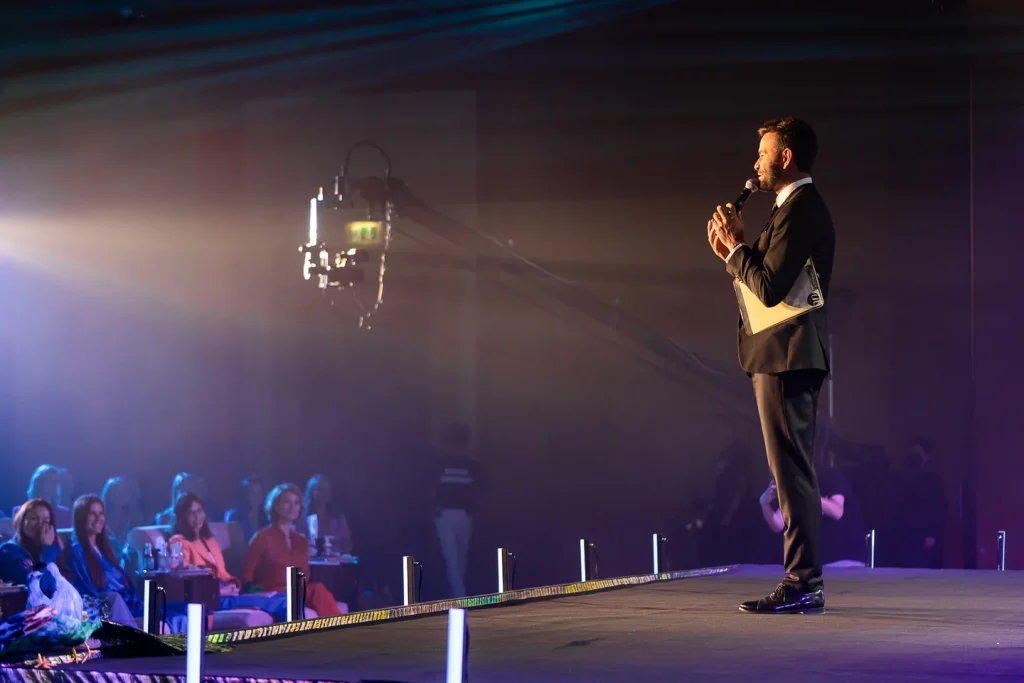
Dubai’s position as a regional hub means this pattern is common. Teams headquartered elsewhere, with staff scattered across the GCC, increasingly use one corporate event in Dubai as the anchor point for the whole group’s year, which raises the stakes on getting the in-person and remote elements both right in the same event.
The part that gets forgotten afterward
A recording sent out the next day is not the same as a properly produced hybrid experience, and treating it as a substitute misses what remote employees actually wanted, which was to feel present, not to watch a video later. Where a recording does add value is as a follow-up for anyone who missed a session live, with key moments timestamped so people can find what matters to them rather than sitting through the full replay.
Getting a hybrid event genuinely right takes coordination across production, hosting, and logistics that most internal teams are not set up to manage alongside their regular jobs. A planner who has run enough of these events knows where the two audiences typically diverge and builds around it from the first planning call, rather than discovering the gap live on the day. That kind of experience is what our corporate events team brings to every hybrid brief, treating the gala dinners and conferences we run as two-audience productions from the outset, not single events with a camera bolted on.
If your next event needs to genuinely work for the people in the room and the people joining from somewhere else, get in touch. The earlier we’re involved, the better both audiences are actually served.

